|
|


|
|

| HOME SEW CRAFTS DECOR SHOP |
Free Sewing BookSewing Lessons For BeginnersChapter Five: Setting Up Your Sewing Machinepage 1 of 3 |

|
|
|
-> table of contents
|
Chapter 5 Page 1 Continue to Chapter 5 page 2
Articles, images and patterns © Christina Sherrod of CraftAndFabricLinks.com unless otherwise noted.
|
Choose The Right Machine
|
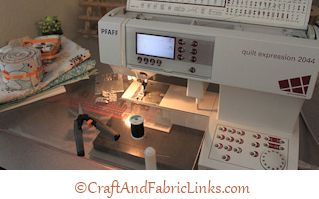 Ready to purchase a new machine? Read our article:
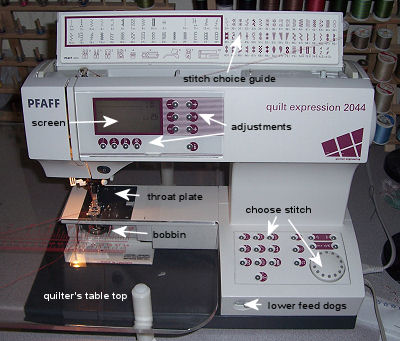
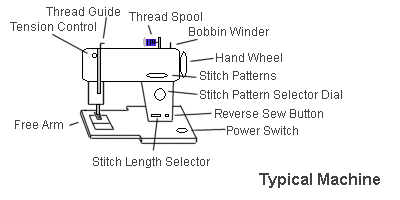
Getting To Know Your MachineReview the photograph below, as well as the following diagram, of a typical sewing machine. Each make of machine is different, so your machine might not look like ours, but our images show standard features found on most machines. Refer to your sewing machine manual to learn about your machine and its parts. Care properly for your machine, and it will take care of you for many years. |
|
|
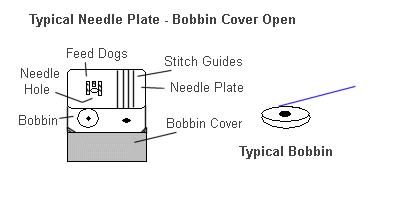
Throat Plate, Bobbin & Feed Dogs
The throat plate has an opening for the needle to pass through, lines that serve as sewing guides, and openings for the feed dogs to fit through (see next section). |
|
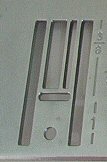
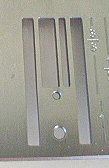
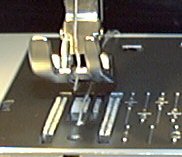
Needle Hole In Throat Plate The needle opening is a single hole, used for straight stitching, or an oblong hole, which allows the needle to make stitches that have width (such as zig-zag stitches). Notice the throat plate on the left, below, has an oblong hole (near the middle of the plate) and the one on the right has just one small circular hole. Use the type on the left for stitches with width (such as zig-zags) and the one on the right for regular, straight stitching, such as quilting or stitching straight seams.
The two long openings on the outer edges allow the feed dogs to come up (an explanation of feed dogs follows). NOTE: A straight stitch throat plate is best when making a straight stitch (regular sewing stitch that is a straight line). It helps prevent the fabric from being pulled down into the machine. Using a sharp needle helps prevent this also, although you must use a ball-point needle for knits. Be careful when using a straight stitch throat plate, however. If you accidentally change to a zig-zag stitch, or another stitch that has a width, while the straight stitch throat plate is in place, you will BREAK YOUR NEEDLE. This is because the needle will come down to the left or right of the small hole and hit the plate, rather than pass through the wide opening shown on the left throat plate above. |
|
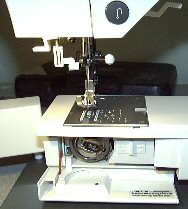
It is the thread that you see when you turn the sewn piece over and look at the back side. When you sew a line, the stitches on top come from the machine's spool of thread, while the underside stitches come from the bobbin. The bobbin, housed under the throat plate, holds the bobbin thread, and is either set into the machine from the top or the front front of the bobbin casing area. In the diagram on the previous page, the bobbin is reached from the top, through a sliding door just to the front of the throat plate; in the photo on the right, the bobbin is reached from below, through a door that opens in the front of the bobbin casing area. |
 Bobbin
|
|
|
Refer to Chapter Six: Guiding Fabric for more information and tips on guiding fabric. Differential Feed And Walking Feet Feed dogs feed from the bottom only. When sewing through two layers of fabric, it is possible that one layer will be fed at a slightly different rate than the other layer. Although your two layers can be perfectly lined up at the start of stitching, by the end of the stitching line the layers can be "off" (one shorter than the other). This is VERY frustrating. Therefore, two different solutions have been developed. If you are lucky, your machine will have differential feed. This can be engaged or not engaged depending on what you are sewing. My Pfaff quilting machine has differential feed and it is truly wonderful. Both layers of fabric are fed at the same rate. If your machine does not have differential feed, you can accomplish the same thing by using a walking foot. It is a special foot that attaches to your machine. A sales person familiar with your type of machine can help you select the right foot for your machine. Presser feet hold the fabric in place as the feed dogs guide the fabric being sewn. They also serve various specialized functions, depending on the type used. Examples of special feet are the rolled hem foot, which causes the fabric to roll under for stitching, and the applique foot, which has an opening in the back to allow the bulk of the satin stitch to pass through. Other special feet that are commonly used include the zipper foot and buttonhole foot. Knowing what types are available, and when to use them, can make all the difference in the quality of your work. These special feet also reduce the problems that cause the most frustration during sewing. Find out what type of feet are available for your machine. Special sewing functions can be performed using other specialty feet such as: bias binder, pintuck feet, felling foot, cording foot, special hemmers and many others. |
|
|
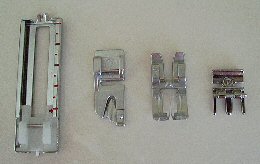 From left to right: buttonhole foot, rolled hem foot, regular foot (allows for zig-zag), and zipper / edge foot (your zipper foot might look very different from the one shown).
* Special Bonus *
Go to: Free Motion Embroidery |
 Free Motion Embroidery
Quick Reference |
Learn To Paint!free video tutorialsVisit my youtube channel. Free videos with step by step instructions. Paint beautiful paintings for your home. |

Please ShareI rely on advertising to keep my site free. Please share with friends. |
Privacy Policy & Terms Of UseBy using our website, you expressly consent to our Privacy Policy and Terms & Conditions. All Patterns, images and instructions are copyright protected. |