|
|


|
|

| HOME SEW CRAFTS SHOP |
|
BUSINESS BOOK
Create Your Way To Success |
| lessons craft patterns sewing patterns |
Chapter 8
|

|
Index & Table of Contents
Please read our Disclaimer and Terms Of Use before reading this book. |
The Magic Of BookkeepingA teacher once told my class that the only thing interesting about bookkeeping is that it contained 3 consecutive double letters. Funny statement, but not entirely true. Bookkeeping is much more interesting than that (I'm not kidding). It is a very clever system that allows a balanced method of tracking the health of a business. Without financial statements, a business owner would quickly lose track of important information, making it impossible to make accurate management decisions. LET'S DO SOME ACTUAL BOOKKEEPINGMore On Debits and Credits I am going to take you through some actual months. I will list the event (sold some products, paid a bill etc.), show you the actual posting (what is debited and what is credited) and show you the change in the financial statements. I am using accrual accounting. First I need to explain more about debits and credits. Unfortunately, this tends to be the confusing part. If you carefully think about it though, it makes sense. Remember that for every post there must be an opposite post (for every debit there is an equal credit). You have the following to post to: asset, liability, income, expense. The first two hit the balance sheet; the last two hit the income statement.
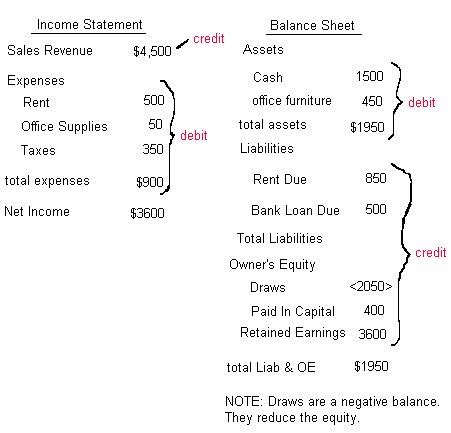
Remember the following: Write that on a "cheat sheet" and keep it with you. Memorize it. Stamp it on a post-it and put it on your forehead. Read as needed. On the balance sheet a debit will: raise your asset or lower your liability. Why? Because assets are debits and liabilities are credits. On the income statement a debit will: raise your expenses and lower or income. Why? Because revenue (income) is a credit and expenses are debits. Another way to look at it: on an income statement, revenue is posted as a credit, so expenses (being debits) lower that amount. Expenses offset revenue. On a balance sheet assets are posted as a debit, so liabilities (being credits) lower that amount. Liabilities offset the assets. Why is it done this way - with balance sheet and income statement reversing debits for good with credit for good? It is so that you can post between the two correctly. Let's say you are paid $5 and that goes to the bank. The $5 is revenue on the income statement and an asset in the bank on the balance sheet. These are both good things. You credit revenue $5 and debit bank balance $5. You have posted two good things and the debits equal the credits. Hopefully the following diagram will help.
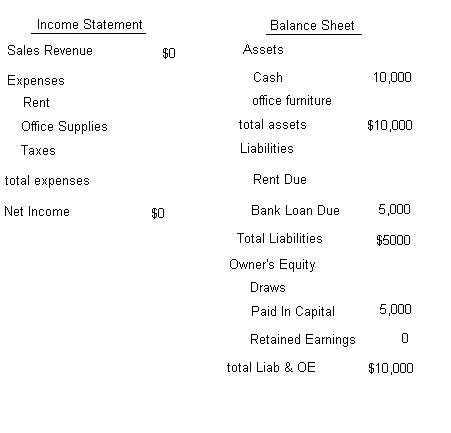
Thoroughly confused? This is the one area that you must review and memorize on your own. The income statement is a list of revenue (credit balances) and expenses (debit balances). If you debit an expense your expense will go up. If you debit a revenue account, your revenue goes down (such as a sales return). If you credit an expense, your expense goes down (a refund on rent), and if you credit your sales revenue, revenue goes up. So, for the income statement, credits are good and debits are bad. For the balance sheet, assets are debit balances and liabilities are credit balances. If you debit an asset, it goes up. Assets are good, so this is a good thing. If you debit a liability account, the liability balance goes down - again a good thing. If you credit an asset, your asset is reduced (such as checking balance falls). If you credit a liability account, it goes up (you owe more on a loan). Therefore, on the balance sheet, debits are good and credits are bad. Owner's Equity: Owner Draws, Paid In Capital and Retained Earnings I'm afraid I must add one more confusing item. Small business owners are usually sole proprietors. They often ask me what happens if they take money out of the business (pay themselves) or put their own personal funds into the business. Sole proprietors do not take actual paychecks from the business (check with your CPA to see if you should have an actual paycheck or just take draws). If you are a very small business and do not take paychecks, how do you pay yourself? Remember from chapter 2 that as far as the IRS is concerned, the profit your business makes is your pay. They don't care if you leave it in the business checking account or not - you still pay income tax based on your personal tax bracket and what the business profit is. If you decide to take money out of the business for yourself, it is recorded as a "draw". The balance sheet is made up of three areas: assets, liabilities and owner's equity. Assets minus Liabilities equals owner's equity. In other words, if the assets were used to pay off all liabilities, the remainder left is the equity the owner has in the company - unless it has been taken out as a draw. So, if you take out a draw, you will debit the equity account. If you put cash into your business, you will credit the equity account (raise it). In order for things to balance, the equity account is like a liability account in that the balances are credits. Liabilities plus owner's equity equals assets on the balance sheet. That is why crediting owner's equity raises the account and debiting lowers the account. Draws are reductions in equity, so that is the only account with a negative balance. "Wait", you say. Why is owners equity a liability? Isn't it a good thing? It is a good thing for the owner, but it is owed to the owner by the business so is listed as a liability. For those of you who love this stuff, the "retained earnings" is made up of net income plus or minus amounts put into or taken out of the business by the owner. Some accounting software systems break out the current year's net income and list that on a separate line; the total of all past years' income is on it's own line, called "retained earnings". In the above example, this is the company's first year of business. Total owner's equity is made up of paid in capital (what the owner put into the business minus draws taken out of the business), and net income (retained earnings). See how it all balances and works together? Pretty cool. Sample Bookkeeping Month 1 You just started your business. You take out a business loan from the bank for $5000 (the loan is a liability - a bad thing), and you put your own personal funds into the business in the amount of $5,000. You open a business checking account in the amount, then, of $10,000.
Debit checking (an asset - a good thing): $10,000 Do total debits equal total credits? Yes! Effect on financial statements:
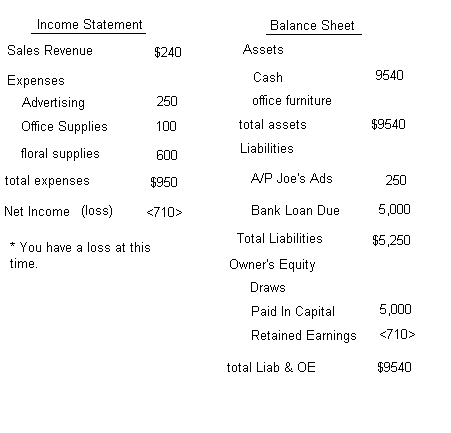
NOTE: OE stands for owner's equity The income statement is not affected (you did not debit or credit any income or expense accounts). The balance sheet is in balance because Assets = Liabilities and Owner's Equity. Month 2 You purchase office supplies for $100. You place an advertisement in the paper for a cost of $250 (it will be paid next month). You purchase floral supplies to make wreaths, in the amount of $600, and you pay cash for the supplies. This is enough to make 60 wreaths. We'll go ahead and expense the floral supplies at this point, because we expect to sell the wreaths soon. Cost of Goods Sold To be more accurate, you would post (debit) this cost to an asset called "wreath supplies" (an inventory account). As you sell wreaths, you would move $10 per wreath from the asset "wreath supplies" to the expense "Cost of Goods Sold". To keep these examples simple, we will make an adjustment later (refer to the last month, when we post remaining supplies to an inventory account). At the end of the month you sell 4 wreaths for $60 each.
Purchase of office supplies:
Purchase of Advertising:
Purchase of floral supplies:
Sales floral supplies: Do total debits equal total credits? Yes! Effect on financial statements:
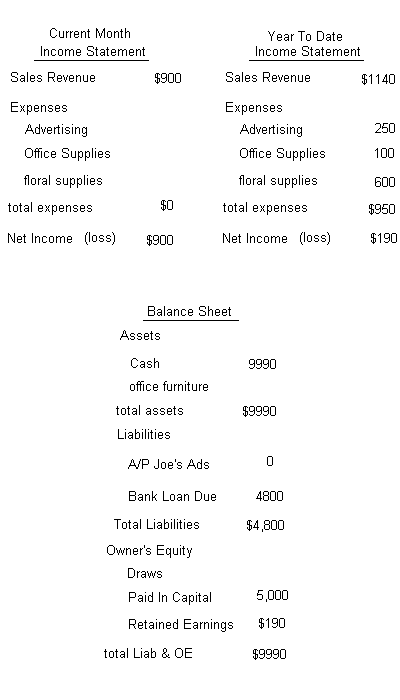
The income statement is affected this month (you have both income and expenses). The balance sheet is in balance because Assets = Liabilities and Owner's Equity. It reflects the net income of the month, as well as the current balance in your asset and liablility accounts. Your loss for the month is $710. Month 3 You sell 15 more wreaths for $60 each (total sales of $900). You pay off the advertisement bill in the amount of $250 You start making payments on your bank loan in the amount of $200.
Sales Revenue
Pay off Advertising bill: $250
Make payment on bank loan: Effect on financial statements:
The income statement is affected this month (you have income but no expenses). Advertising is NOT an expense. It was recorded last month as an expense. It is merely a debt being paid this month; it affects the balance sheet, but not the income statement. The balance sheet is in balance because Assets = Liabilities plus Owner's Equity. It reflects the year to date net income, as well as the current balance in your asset and liablility accounts. Month 4 (Final month of the year). You sell 25 wreaths for $60 each (total sales of $1500). You make another payment on your bank loan in the amount of $200. You decide to "pay yourself" $2,000 plus pay yourself back the $5,000 you originally put into the business. To "pay yourself" you take out a draw for $2,000, plus you pay yourself back $5,000. You purchased enough floral supplies to make 60 wreaths. You expensed all of the cost of the supplies at the time of the purchase. You have sold 44 wreaths, meaning you have supplies on hand still for 16 wreaths. You had paid $600 for the supplies to make 60 wreaths, so the cost per wreath is $10. You must now make an adjustment for supplies still in inventory. The IRS doesn't worry about small amounts of supplies in inventory, but if it adds up, you must count it as inventory. This means you don't count it as an expense. Your CPA can give you advice on this. I am moving the remaining supplies from expense to inventory to illustrate how it is done. You have enough supplies to make 16 wreaths, so you have $160 in inventory ($10 x 16). At this point, you could move the cost of your supplies used from "floral supplies" to "Cost of Goods Sold".
Sales Revenue
Adjust for inventory (formerly expensed): $250
Make payment on bank loan:
Post Draw Effect on financial statements:
The income statement is affected this month (you have income and an adjustment to expenses). Your balance sheet is affected (cash, the bank loan and your draw and removal of paid in capital). The balance sheet is in balance because Assets = Liabilities and Owner's Equity. It reflects the year to date net income, as well as the current balance in your asset and liablility accounts. How Can I Be Showing A Profit If I Have No Money?WAIT! This shows you made a net income of $1,850 for the year. Yet, you do not even have enough in the bank to pay off the bank loan. How can this be? Shouldn't you have cash in the bank to cover the loan, plus what you made in profit? Where did the money go? Is there a mistake somewhere? No - there is no error. Yes, the business did make a profit of $1,850, and you will have to pay income tax on that. Where is it? You took out a draw for $2,000, remember? Plus, you have some of your profit wrapped up in inventory. It is possible to show a profit on the books, yet have no money in the bank. Be sure you understand this. Remember, also, that in this example (sole proprietor), the business owner's income tax is based on the business profit of $1,850, not the $2,000 taken out as a draw. Be sure you understand that concept as well. |

| Index & Table of Contents Chapter 1 Chapter 2 Chapter 3 Chapter 4 Chapter 5 Chapter 6 Chapter 7 Chapter 8 Resource Links |
Visit our store!
|
Free Videos
|


Please ShareI rely on advertising to keep my site free. Please share with friends. |
Privacy Policy & Terms Of UseBy using our website, you expressly consent to our Privacy Policy and Terms & Conditions. All Patterns, images and instructions are copyright protected. |