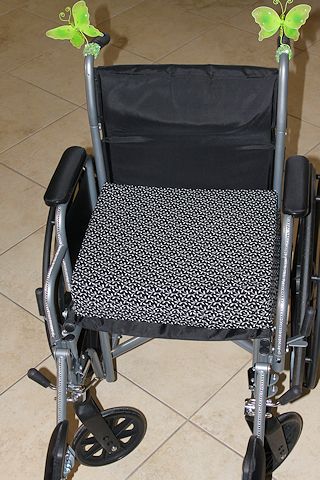
|
Wheelchair Cushion
Add comfort and style to your wheelchair with a custom seat cushion.
Project By Kayla Sherrod
|
These instructions will make a perfect fitting wheelchair seat cushion and cover, with mitered corners and envelope back opening.
This pattern can be used to
cover any square or rectangular cushion. We layered high density foam with low density foam to create a very comfortable seat cushion.
Adjust instructions to make any size you need.
|
All Patterns, images and instructions are copyright protected.
Please read our Terms & Conditions before using our patterns.
|
Supplies Needed
One piece of high density foam, measuring 15" x 17" x 2". One piece of lower density foam, measuring 15" x 17" x 2" (or size you need for your chair).
NOTE: Measure your wheelchair seat to be sure this is the correct size for your chair. We purchased our foam at a fabric store, and it was already pre-cut to this size, which was perfect for our chair. We experimented with foam pieces and found that placing the high density foam on the bottom and layering the lower density foam on top provided the most comfort.
Enough fabric to cover your cushion. 1 yard worked for our chair. NOTE: Pre-wash and dry your fabric.
Determine Size
Measure the length, width and thickness (depth) of your cushion(s). Write down those numbers.
For our project, the depth of the two layers together was 4". Each cushion measured 15" x 17". Therefore, our finished cushion (two layers together) was 15" x 17" x 4"
|
| |
Wheelchair Bling
Add bling and decor to your wheelchair!
|
|
Cushion Cover Top
NOTE: Use a 1/4" seam allowance.
The formula for the cushion cover top length (L)is:
L = length of cushion plus cushion depth plus 1/2" (for seam allowances).
Using our cushions, L = 17" plus 4" plus 1/2".
The width (w) = width of cushion plus depth of cushion plus 1/2".
Using our cushion, W = 15" plus 4" plus 1/2".
For my cushion cover top, I cut a piece of fabric measuring 21½" x 19 ½".
|
 |
Cushion Cover Back
The back is made up of two pieces. The width is the same as the top piece. For the length, we will use the measurement of the top length, and adjust it a bit. Add 3" for overlap plus 1.5" for
hems. The width is still 19.5", and the length is 26".
For my cushion cover back, I cut a piece of fabric measuring 26" x 19.5".
Cut the back piece into two pieces, across the width. I made my cut about 8" from one end.
Hem Back Pieces: Turn under one edge of both back pieces 1/4". Press. Turn under another 1.5". Press. Topstitch hems.
NOTE: The images below are of a cushion cover I made to use as a doll bed. The cushion worked as the mattress and the cover made a nice "matress" cover.
|
edges hemmed
|
edges overlaped
|
Sew Back to Front
Place the front piece on a flat surface, right side up. Place one of the small back piece on top of the front piece, wrong side up. Place it so that unhemmed edge lines up with the top edge of the front, and the hemmed edge is toward the bottom. Place the second back piece on top of the other two pieces,
wrong side up. Place it so that the unhemmed edge is lined up with the bottom edge of the front, and the hemmed edge is toward the top.
Stitch around all four sides. Refer to drawing.
|
|
Miter The Corners
Draw Miter Lines Divide the depth of your cushion in two. Our cushion depth was 4". Therefore I used a measurement of 2". Use this number as the size of your square.
Using a quilter's square, or other measuring device, and a fabric marker draw a square in each corner. I drew a 2" in each corner. The 2" started at the stitch line of the seam.
|
|
|
Cut Miter Square Using sharp scissors, cut out a square ¼" from the square you drew. Your cut out will be ¼" SMALLER than the square you drew.
|
|
|
Pull apart the layers and line up the seams so one is on top of the other. Line up the top cut edges. Pin layers together. Stitch layers. The stitch line is enhanced in red in the image below. This creates the mitered corner. Repeat on all four corners.
|
|
Turn cover right side out. Place foam pieces inside cover.
|
|
|